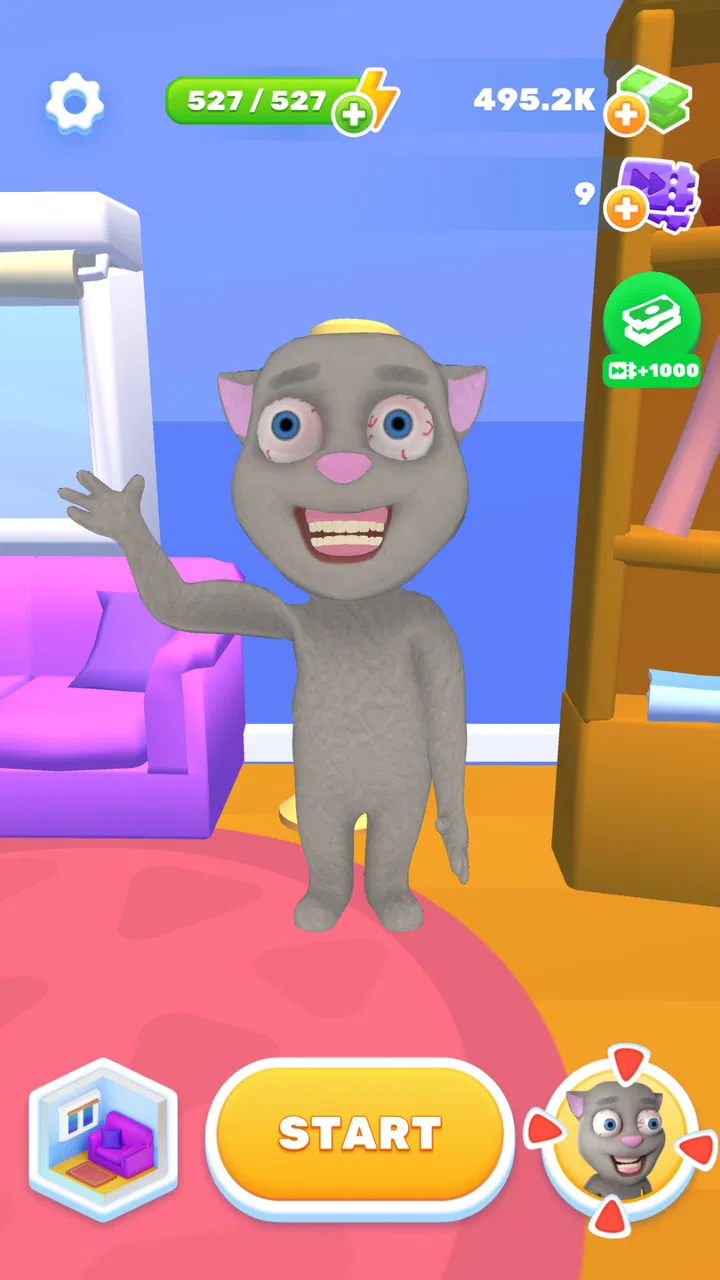
Kick Monster・Smash Giants Game
- 4.2
- Rating
- 10.00M
- Installs
- Free
- Price

 Analysis by App-foxy
Kick Monster is a casual action game built around one simple pleasure: taking on oversized monsters with exaggerated weapons and watching the screen turn into a noisy, destructive playground. I found it easiest to enjoy when I wanted a short burst of uncomplicated entertainment rather than a deep role-playing game or a carefully balanced competitive challenge. Its central appeal is the directness of the action. You see a huge target, choose how to attack, and keep pushing through the encounter until the boss is beaten.
That focus has helped the game reach a broad audience. It is free to play, made by Pixeland OU, and carries an Everyone 10+ rating. On the store, it holds a 4.2 average from around 25K ratings and has passed 10M+ installs, which fits the kind of quick, accessible experience it offers. I would describe it as a pick-up-and-play monster-smashing game: easy to understand within moments, but more enjoyable when you learn how to manage its rhythm instead of tapping without thought.
Why the giant-monster destruction works
The most important capability here is the ability to turn a large boss encounter into a relaxed, repeatable action loop. The game does not ask me to study complicated controls before I can have fun. Its appeal comes from the contrast between the size of the enemies and the simplicity of the interaction. Every attack feels aimed at making visible progress against something much larger than the player character.
You May Also Like

 Pandora - Music & Podcasts
Pandora’s Music Is Easy to Start, but Harder to Recover
Pandora’s strength is its low-effort path from a seed to a station. Its weak spot is how much confidence it asks you to place in connection, setup, and quiet recovery.

 8 Ball Pool
 Is Built on Rivalries, Rematches, and Routine
A close look at the rivalries, rematches, shared routines, and unanswered safety questions that turn a quick pool match into a persistent mobile community.

 Samsung Music
’s Quiet Strength Is Playing What You Already Own
Its reach comes less from spectacle than from dependable access to a personal library. That simplicity is both the app’s strongest retention engine and its ceiling.

 AccuWeather: Weather Radar
AccuWeather Review: A Quick, Clear Forecast for Everyday Decisions
For everyday plans, the best forecast is the one you can understand quickly. AccuWeather makes rain timing, radar, and local conditions easy to act on, with a few trade-offs.

 Hill Climb Racing
Why Hill Climb Racing Still Turns Crashes Into One More Run
A tiny car, a bumpy hill and one more upgrade: Hill Climb Racing keeps resurfacing because its simple chaos makes every near-miss feel personal.

 AliExpress - Shopping App
AliExpress Makes Global Shopping Feel Personal, but Shoppers Bear the Risk
AliExpress turns a global marketplace into a pocket-sized discovery engine. Its reach is useful, its shopping loop compelling, and its trade-offs easy to miss.
More From Our News Desk
View All News


That makes the destruction feel satisfying even when I only have a few minutes. A conventional casual puzzle game may ask me to plan combinations, while an endless runner may demand constant attention to movement. Kick Monster sits somewhere else. It gives me the fantasy of confronting a ridiculous threat with equally ridiculous weapons, then lets me enjoy the result without requiring a long session.
The real strength is not complexity; it is immediate feedback. The game understands that a giant creature and a powerful-looking attack can provide a clear reward on their own. When I am tired, waiting for an appointment, or taking a break between tasks, that clarity is more useful than a complicated progression system would be.
Learning the attack rhythm
At first, it is tempting to treat every encounter as a button-pressing exercise. I had more fun once I started paying attention to the pace of each attack and the moment when continuing to attack was more valuable than rushing to use the next option. The practical lesson is to treat each monster as a short sequence rather than one long health bar.
I also recommend resisting the urge to spend every powerful option immediately. A strong attack can feel impressive, but saving it for a difficult phase or a boss that is close to being defeated can make a session smoother. This is one of the small decisions that separates a satisfying run from a repetitive one. The game remains casual, but casual does not have to mean careless.
Another useful habit is to use the early part of an encounter as a test. I watch how quickly ordinary attacks make progress, then decide whether the situation calls for patience or a stronger response. That approach prevents me from treating every monster as equally demanding. It also gives the action a little more texture than simply repeating the same input until the screen changes.
What the weapons add to the experience
The weapons are important because they give the destruction its personality. A standard attack against a monster can become visually dull, while an unusual weapon makes the same basic goal feel different. I would not play this game expecting a realistic weapons simulation. The fun comes from the exaggerated presentation and the sense that the game is encouraging me to enjoy absurd solutions.
In practice, I found the weapon variety most useful as a way to prevent short sessions from feeling identical. When I am only playing briefly, I do not need every tool to create a completely new strategy. I do need enough variation to make the next encounter feel like a small change rather than a copy of the previous one.
There is a trade-off, though. The more the game leans into spectacle, the less it resembles a tactical action title. Players who want precise hitboxes, complex character builds, or carefully tuned combat may find the weapons entertaining but shallow. The game is better understood as casual destruction with light decision-making than as a demanding combat simulator.
How it feels during an ordinary play session
A typical session works best when I approach it with a clear limit. I open the game for a quick break, play through a few encounters, and stop before the repeated structure starts to wear thin. Because the main idea is so easy to grasp, there is little mental overhead. I do not have to remember a large story, coordinate with other players, or prepare a long strategy before starting.
That simplicity is especially helpful on a phone. The game suits the kind of fragmented time that mobile gaming often involves: a short wait, a commute break, or a few minutes after finishing a chore. I would not choose it for a long evening when I want a rich adventure, but I can see myself returning to it when I want action without commitment.
The best everyday scenario is a ten-minute reset after work or study. I can start an encounter, focus on the monster in front of me, and enjoy a clear sense of progress without needing to remember where I left off emotionally or narratively. The lack of a demanding story is a benefit in that situation. I am not being asked to invest in a fictional world when all I want is a quick distraction.
It also works for players who are introducing someone to mobile games. The basic premise is understandable without a tutorial-heavy explanation: attack the monster, use the available tools sensibly, and keep going. That makes it more welcoming than many action games that bury their enjoyable parts beneath menus, equipment screens, and long introductory sequences.
Where the free-to-play model affects decisions
The game is free to download and play, but optional in-app purchases range from $0.99 to $89.99 per item. That wide range matters because the experience can feel very different depending on how disciplined the player is around purchases. I recommend treating the paid options as a convenience rather than a requirement and deciding on a personal spending limit before playing.
For me, the sensible approach is to enjoy the basic loop first. If the monster encounters are not entertaining without spending money, purchasing something will not solve the underlying problem. If the game does provide the kind of short relaxation I want, then I can judge any optional purchase by whether it genuinely improves my routine rather than by how impressive it looks in the moment.
Parents should also pay attention to the age rating and the purchasing environment. The game is rated Everyone 10+, but that does not remove the need for sensible device controls when younger players use a phone or tablet. The combination of free access and optional purchases is common in mobile games, yet it is still worth setting expectations clearly before handing the device to a child.
Progress without turning the game into homework
One of the more useful ways to play is to view each session as practice in recognizing the game’s tempo. I do not need to chase perfect performance every time. Instead, I focus on learning which attacks feel efficient, when a boss deserves more patience, and when I am spending resources simply because I am impatient.
This mindset helps preserve the relaxing quality. If I turn every encounter into a personal test, the game can become more stressful than it needs to be. If I ignore every decision, the action can become background noise. The middle ground is to make one or two deliberate choices per encounter, then let the spectacle do the rest.
That is also where the game differs from many casual alternatives. A match-three title usually rewards planning several moves ahead, while a runner rewards reflexes and route awareness. Kick Monster instead rewards attention to attack timing and resource restraint. It is a better alternative when I want to feel powerful and active, but not when I want a puzzle that keeps challenging my reasoning.
The best use case for this particular game
Kick Monster is at its best for players who enjoy short action loops and exaggerated boss battles. If you like the idea of dismantling a huge enemy with entertaining weapons, the central concept is immediately appealing. You do not need to be a fan of complex fantasy lore or competitive leaderboards to understand why the encounters are enjoyable.
I also think it suits people who lose interest in games that take too long to become fun. Many mobile adventures ask for patience before the main systems open up. Here, the monster-smashing premise is the attraction from the beginning. That makes it a useful choice for a spare-time game, especially when I want something more active than a passive video but less demanding than a full console-style experience.
A good personal routine would be to play it in short blocks and stop when the loop starts to feel predictable. That is not a criticism unique to this title; it is the natural limit of a focused casual game. The mistake would be expecting the same depth or variety from it that I would expect from a large role-playing game. Used as a compact action break, it makes more sense.
The game is less suitable for someone who wants a strong narrative, strategic team composition, or a highly competitive environment. It is also not my first recommendation for players who dislike free-to-play pressure in any form. Even when optional purchases are easy to ignore, their presence can change how some people experience progression and rewards.
Small habits that make the loop more enjoyable
My first tip is to avoid playing while distracted by several other tasks. The controls may be accessible, but the game is more satisfying when I watch the encounter and notice the difference between steady progress and wasted attacks. A few focused minutes feel better than a longer session where I tap automatically.
Second, I save the most noticeable tools for moments that actually need them. Using everything at once creates a brief burst of excitement, but it can leave the next part of the session feeling flat. Holding something back gives me a reason to stay engaged and makes a difficult encounter feel like a problem I solved rather than a screen I waited through.
Third, I judge the game by the quality of its short sessions, not by how long I can play continuously. This is a useful trade-off. A title designed for quick monster battles may be doing its job even if it becomes repetitive after an extended stretch. That perspective prevents me from demanding a marathon experience from a game built around instant, casual action.
Finally, I would keep an eye on the current version installed on the device. The listed current version is 2.0.14, and the game supports devices running Android 7.1 or later. Those details are practical when deciding whether an older phone or tablet is likely to be suitable. On a compatible device, the main question is less about technical ambition and more about whether this particular style of repeated boss destruction matches your taste.
Who gets the most from the experience
The strongest audience is someone who wants an uncomplicated mobile game with a clear target and a playful sense of scale. You will probably enjoy it if the thought of attacking oversized monsters sounds entertaining by itself, especially when you prefer short sessions over lengthy campaigns. The free entry point also makes it easy to test the idea before deciding whether it deserves space on your device.
It is a particularly good fit for casual players who want action without a steep learning curve. The game does not demand that I memorize a complicated control scheme before I can participate. Its challenge comes from making sensible choices inside a straightforward loop, which gives it more involvement than a purely passive time-killer while keeping the barrier to entry low.
Players who should skip it are those looking for deep customization, a substantial story, or a carefully competitive combat system. If your favorite part of a game is comparing detailed builds or mastering a large roster of abilities, the focused monster-smashing format may feel too narrow. A puzzle game is likely a better choice when you want mental planning, and a larger action adventure is preferable when you want exploration and narrative momentum.
My final view is positive but deliberately measured. Kick Monster succeeds because it knows what its main attraction is: giant enemies, amusing weapons, and quick action that can help me unwind. It does not need to pretend to be a deep adventure to be worthwhile. The important question is whether you want a compact destructive break or a game that keeps expanding its systems.
For the right player, I would recommend giving it a fair trial without rushing toward purchases. Start with short sessions, learn the attack rhythm, and use the stronger options with some restraint. If that simple routine remains fun, the game can become a reliable casual companion. If the repeated encounters begin to feel like work, that is a sign to move on rather than spend more. In my experience, its value comes from the immediate pleasure of the loop, and that is exactly where Kick Monster feels most convincing.
FAQs for Kick Monster・Smash Giants Game
01What is Kick Monster・Smash Giants Game about?
Kick Monster・Smash Giants Game is a casual action game built around launching powerful kicks at oversized monsters and giant enemies. The main objective is to defeat each creature by timing attacks, improving your character, and progressing through increasingly challenging encounters. Its simple controls make it easy to start, while upgrades, stronger opponents, and destructive environments provide enough variety for short, entertaining play sessions.
02Is Kick Monster・Smash Giants Game free to download and play?
The game can generally be downloaded and played without an upfront purchase, but availability of optional in-app purchases may depend on the version and platform. These purchases can potentially provide upgrades, currency, cosmetic items, or other advantages. Players should review the store listing before installing, especially if children will use the device, and check whether the game includes advertisements or paid features during gameplay.
03Does the game require an internet connection?
The basic gameplay appears suited to quick, casual sessions, and some parts may work without a constant internet connection. However, online access can still be required for advertisements, reward systems, updates, cloud features, analytics, or in-app purchases. Because requirements may change between versions, it is best to check the current Google Play or App Store listing if offline play is an important reason for downloading.
04Is Kick Monster・Smash Giants Game suitable for children?
The controls and straightforward monster-smashing concept may be accessible to younger players, but parents should review the game’s age rating and content before allowing children to play. The cartoon-style combat is generally presented as exaggerated action rather than realistic violence, yet advertisements, purchases, and difficulty progression can still affect the experience. Parental controls are recommended, particularly on shared devices.
05What should I know about gameplay, controls, and progression before downloading?
Kick Monster・Smash Giants Game is designed for players who prefer simple, immediately understandable mechanics rather than a complex role-playing system. You typically focus on tapping, swiping, or timing attacks to kick enemies and cause damage, then use rewards to improve performance. Progression can become more demanding as monsters grow stronger, so the game is best suited to casual players who enjoy repetitive action, upgrades, and short levels.
Pros
- Simple controls make it easy to start playing immediately.
- Short levels are convenient for quick gaming sessions.
- Satisfying impact effects make giant-smashing feel rewarding.
- Progression gives you reasons to keep upgrading your character.
- Bright visuals are suitable for casual players of different ages.
Cons
- Gameplay can become repetitive after several similar stages.
- Some upgrades may require considerable grinding to unlock.
- Frequent ads can interrupt the flow between levels.
- Difficulty balance may feel uneven in later encounters.
- Limited strategic depth may disappoint experienced action gamers.

Kick Monster・Smash Giants Game
Gallery